What is document translation?
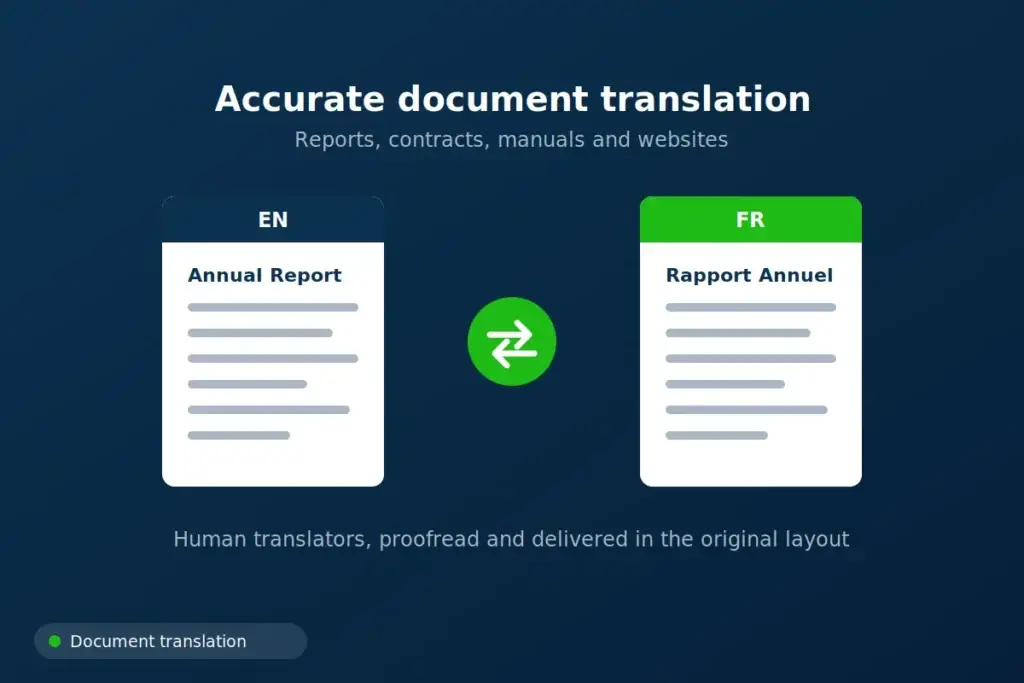
Document translation services in Nairobi convert written content from one language into another while keeping its meaning, tone, and formatting. Unlike interpretation, which handles spoken words, translation deals with text.
Document translation services in Nairobi: what we translate
- Reports, proposals, and policy documents
- Contracts and legal agreements
- Academic papers and certificates
- Training manuals and user guides
- Marketing materials and brochures
- Event programmes, invitations, and signage
- Website content, which helps your organisation reach new audiences TRANSLATION
What makes a good translation
- Accuracy. Facts, figures, and terminology must be correct.
- Natural language. The text should read as if it had been written in the target language originally.
- Cultural fit. Good translators adapt idioms and references for the audience.
- Consistency. Terms, names, and style stay uniform across a whole document.
- Confidentiality. Sensitive documents should be handled with care.
Why not use machine translation alone?
Automatic tools can give a rough idea of a text, but they often miss context, tone, and specialist terminology. For contracts, official records, health information, or public-facing content, human translators protect you from costly mistakes.
How to prepare your documents
- Send editable files (such as Word documents) where possible.
- Tell us the target language, the audience, and the purpose of the text.
- Share any glossaries, preferred terms, or earlier translations.
- Allow enough time, since long or technical documents need review and proofreading.
How our document translation process works in Nairobi
Getting your documents translated should be simple and stress-free. Here is how we handle every project at Auron Nexora Ltd, from your first message to the final file.
1. Brief
Send us your document along with the language pair, the purpose of the translation, and your deadline. Tell us who will read it, such as clients, a government office, or the public, so we can match the tone. Share any glossaries or preferred terms, and send editable files such as Word documents where you can.
2. Quote
We review your document and send a clear quote based on the length, the subject matter, the languages, and your deadline. You’ll know the cost and timeline before any work begins.
3. Translation
A translator who knows your subject area translates the text, keeping the meaning, tone, and formatting of the original. Names, figures, and technical terms are handled consistently throughout.
4. Proofreading
Before anything reaches you, the translation is checked for accuracy, grammar, terminology, and layout. This step catches small errors that can cause big problems in contracts, reports, and official records.
5. Delivery
We send the finished translation in the file format you need. If you have changes or questions, we’ll work through them with you. Your documents are handled confidentially from start to finish.
Why professional document translation matters
A small translation error can delay a visa application, weaken a contract, or confuse the readers of a report. Professional human translators understand context, legal and technical terminology, and the cultural details that automatic tools often miss. They also keep your formatting, headings, and tables intact, so the translated document looks as polished as the original.
For businesses and organisations in Nairobi, accurate translation also builds trust. Clients, partners, and regulators take a document more seriously when it reads naturally in their own language.
Tips to get the best document translation results
You can help us deliver faster and more accurate work by preparing a few things in advance:
- Send the final version. Changes made after translation starts can add time and cost.
- Use editable files. Word, Excel, and PowerPoint files are easier to translate than scanned images or PDFs.
- Share reference material. Glossaries, brand terms, and earlier translations keep the wording consistent.
- Tell us the audience. A legal document for a court is written differently from a brochure for customers.
- Plan. Long or technical documents need time for translation and proofreading, so allow for it in your schedule.
Need a document translated? Send us your files for a quote.