What is sign language interpretation?
Sign language interpretation converts spoken language into sign language, and the reverse, so Deaf and hard-of-hearing people can take part fully in meetings, training sessions, and public events. Sign languages are complete languages with their own grammar and structure. They are not a signed version of spoken words, which is why a professional interpreter does far more than translate word for word. They carry meaning, tone, and intent from one language to another in real time.
Kenyan Sign Language and International Sign
In Kenya, Kenyan Sign Language (KSL) is the main language of the Deaf community, and it is recognised in the Constitution of Kenya. For international audiences, International Sign is sometimes used. It is a more flexible form that draws on signs from many countries, and it is common at regional and global gatherings where delegates come from different sign language backgrounds.
KSL and International Sign are not the same, so confirm which one your participants prefer when you plan your event. Choosing the right one from the start means everyone can follow the discussion without confusion.
How sign language interpretation works
At conferences and meetings, most sign language interpreting is done simultaneously. The interpreter listens to the speaker and signs almost at the same time, then relays Deaf participants’ responses in spoken language for the rest of the room.
This is demanding work and requires full dedication. It requires strong command of both languages spoken, subject knowledge, and constant concentration. For that reason, interpreters usually work in pairs or teams and swap regularly. Preparation also makes a real difference. When interpreters receive the agenda, speaker notes, and technical terms beforehand, they can research vocabulary and agree on the right signs for specialised terms.
Why it matters for your event
- Inclusion. Deaf and hard-of-hearing delegates get equal access to information and discussion, rather than relying on written notes or a colleague.
- Reach. Your message reaches a wider audience, including through live-streamed and recorded sessions.
- Good practice and compliance. Many donors, public institutions, and organisations now expect accessibility to be built into events from the planning stage.
- A stronger reputation. Accessible events show that your organisation values every participant and takes inclusion seriously.
Planning tips
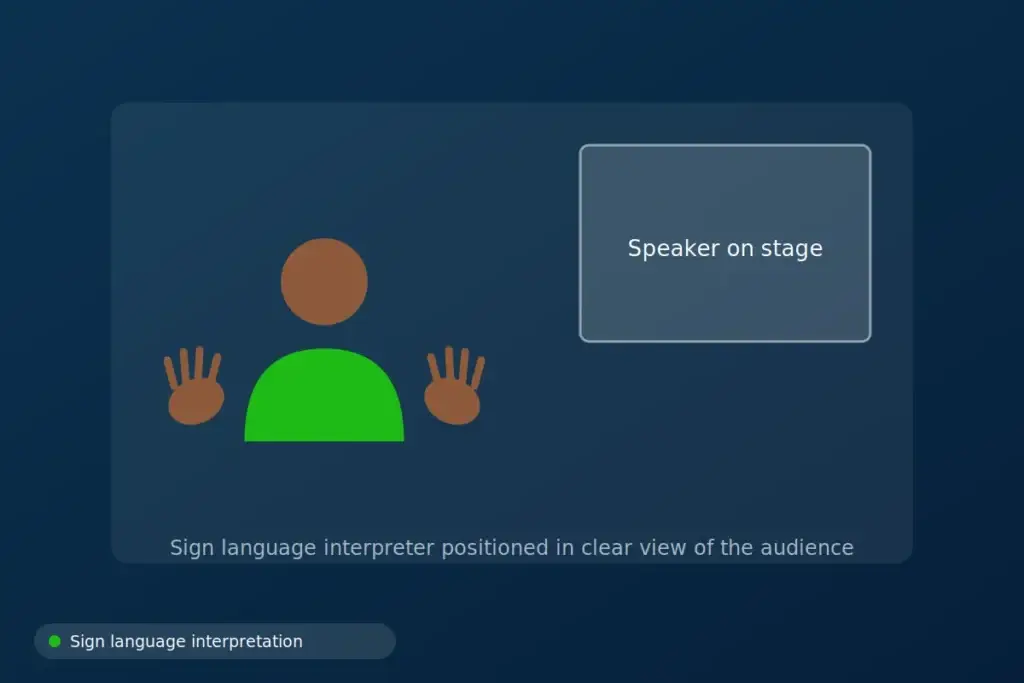
- Place the sign language interpreter where Deaf attendees can clearly see them, usually near the speaker, with good lighting and a plain background.
- Book more than one interpreter for events longer than an hour, so they can rotate and keep quality high.
- Share your agenda, presentations, and any technical terms in advance.
- Tell speakers to pace themselves and avoid talking over each other, so the interpreter can keep up.
- For online or streamed events, make sure the interpreter is visible on screen and pinned in the video view.
- Confirm early whether your participants use KSL or International Sign.
Who needs sign language interpretation?
Any organisation that brings people together can benefit. Conferences, workshops, staff training, public forums, and community meetings all become more accessible with an interpreter present. Government offices, NGOs, schools, and corporate teams also use sign language interpreters for important one-to-one conversations, such as interviews, briefings, and formal meetings. If you expect even one Deaf participant, it is worth arranging an interpreter, because without one, that person is excluded from the whole event.
Sign language support from Auron Nexora Ltd
At Auron Nexora Ltd, our sign language work extends beyond interpretation to training, helping organisations and teams communicate more inclusively. Tell us your event date, venue, and the sign language your participants use, and we will help you plan the right interpreting team.